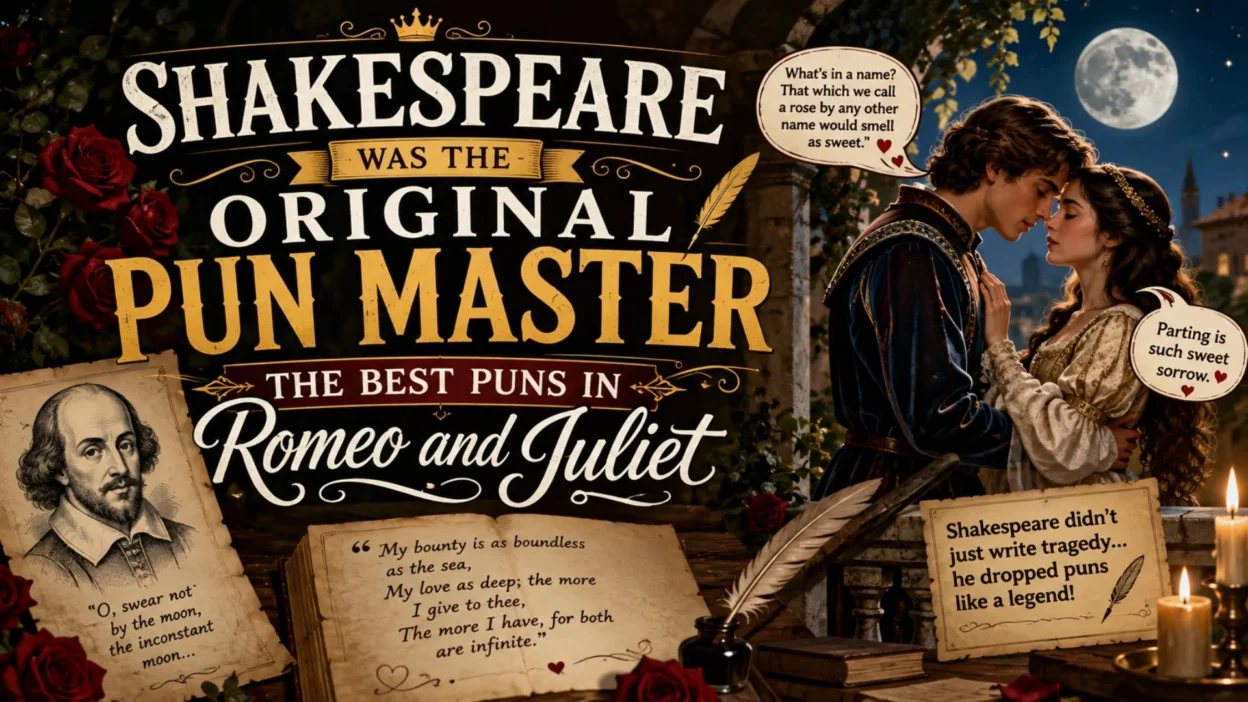
Let’s be honest—when you think of Romeo and Juliet, you probably picture star-crossed lovers, dramatic balcony scenes, and tragic endings. And yes, there’s plenty of that!
But here’s the secret Shakespeare didn’t want you to forget: he was also a massive pun-lover. 😏 Before there were viral tweets and witty Instagram captions, the Bard was dropping clever wordplay like a modern-day meme lord.
In fact, the puns in Romeo and Juliet are so frequent that some critics accused Shakespeare of “over-indulgence in punning and rhyming. “But why so serious? Let’s break down the funniest, cleverest, and most groan-worthy puns from this iconic play—all translated into modern humour so you can enjoy them even if you don’t speak Elizabethan English.
Warning: Some of these will make you laugh. Some will make you roll your eyes. And a few might even make you want to re-read the play with fresh eyes. Grab a snack and let’s dive in! 🍿
We’ll Not Carry Coals. 🔥
The play kicks off with servants Sampson and Gregory engaging in a battle of wits—and it’s basically the 16th-century version of a Twitter roast. The exchange goes like this:
Sampson: “Gregory, on my word, we’ll not carry coals.”
Gregory: “No, for then we shall be colliers.”
Translation and Humour: In Elizabethan England, “carrying coals” meant accepting insults or doing menial work. Sampson declares he won’t be disrespected, and Gregory fires back by saying they’d be “collier” (coal deliverers)—a low-status job. But the real gold? The pun continues with “choler” (anger) and “collar” (a noose).
Modern “Dad Joke” Version:
- “I’m not carrying coals for anyone!”
- “Relax, you’re not a collier—you just have a hot temper!”
Why It’s Funny: Shakespeare immediately establishes that these characters are feisty, working-class, and ready to trade verbal blows. It’s the first sign that wordplay was Shakespeare’s favourite weapon.
Mercutio’s Queen Mab Speech: The Original Rap Diss 🧚♂️
Mercutio is arguably the funniest character in Romeo and Juliet, and his Queen Mab speech is loaded with wordplay that modern audiences can appreciate—even if some of the puns are lost in translation.
Mercutio describes Queen Mab as a tiny fairy who causes dreams, but he doesn’t stop there. He lists the absurd things she does, like giving soldiers dreams of cutting foreign throats and making maidens dream of kissing.
The Pun: Mercutio says she “plagues” lovers who dream of love. The word “plague” sounds similar to “play” and “please”, creating a pun that suggests she both torments and entertains lovers.
Why It’s Funny: It’s Shakespeare saying that love is both a beautiful dream and a painful nightmare—and Mercutio is here for the chaos.
Modern “Caption Gold” Version:
- “When you dream of your crush but they’re not texting back, Queen Mab is laughing somewhere.”
- “Allergic to love? Queen Mab is to blame.”
The Nurse’s Malapropisms: The Original Verbal Flub
The Nurse is one of Shakespeare’s funniest comic reliefs, and her malapropisms are legendary. A malapropism is when someone substitutes a word with a similar-sounding one that means something entirely different—and hilarity ensues.
Example: The nurse says, “I desire some confidence with you”, but she meant “conference” (a meeting). Benvolio then deliberately mocks her by saying she’s going to “indict” Romeo rather than “invite” him—an intentional pun to highlight her lack of education.
Why It’s Funny: Shakespeare uses the Nurse’s mistakes to make the audience laugh at her, but also to show that low social status doesn’t mean a lack of heart. She’s comic relief with a purpose.
Modern “Mom Joke” Version:
- “I need some confidence with you.” — “So you want me to cheer you up?”
- “Indict me? But I haven’t done anything wrong!”
He Jests at Scars That Never Felt a Wound. 🩹
Romeo says this line when he sees Juliet on the balcony, referring to Mercutio, who mocks love despite never truly being in love himself.
The Pun: “Scars” refers to emotional wounds, and “never felt a wound” means Mercutio doesn’t understand real heartbreak.
Why It’s Funny (and Clever): It’s a self-aware jab at people who give relationship advice but have never been in a serious relationship. Sound familiar?
Modern “Burns” Version:
- “You can’t give dating advice if you’ve never been in a relationship.”
- “Stop judging my love life—you don’t even have a love life!”
Give Me a Case to Put My Visage In. 🎭
Romeo says this before the Capulet party, asking for a mask to hide his face. The pun plays on “visage” (face) and “visor” (mask).
The Joke: Romeo says he needs a “case” for his “visage”, implying that his face is an object to be packaged.
Modern Version:
- “I need a mask for my face—and my feelings.”
- “Cover me up; I’m too recognisable for this party.”
Why It’s Clever: It foreshadows Romeo’s later line about Juliet being a “saint” and him being an unworthy “pilgrim”, continuing the theme of disguise and identity.
The Dove and Crow Puns 🕊️🐦⬛
When Romeo first sees Juliet, he says she outshines other women like a “dove among crows”. But he also uses wordplay to contrast darkness and light.
The Pun: The word “dove” echoes “love”, and “crow” sounds like “groan”, subtly playing with Juliet’s name and Romeo’s previous love for Rosaline.
Modern Version:
- “She’s the sunshine while everyone else is just… meh.”
- “You’re a glow-up in a world of filter fails.”
Why It’s Funny: It’s Romeo’s way of saying, “I was crushing on Rosaline, but Juliet makes her look like yesterday’s news.”
Mercutio’s “Plague on Both Your Houses” 🏠
Mercutio famously curses the Montagues and Capulets after being fatally wounded. He shouts, “A plague on both your houses!” But wait—there’s a pun.
The Pun: “Plague” literally means disease, but it’s also a play on “plague” meaning “curse”. It’s a darkly funny moment because Mercutio takes his dying breath to troll both families.
Modern Version:
- “You both deserve a timeout—forever.”
- “I’m done with both of you, and I’m not even exaggerating.”
Why It’s Funny: Even in death, Mercutio can’t resist a clever jab.
Ask for me tomorrow, and you shall find me a grave man. ⚰️
Mercutio says this after being stabbed by Tybalt. It’s one of the most famous puns in Romeo and Juliet because it’s tragically funny.
The Pun: “Grave” means both “serious” and “dead”. Mercutio says he’ll be a “grave man” tomorrow—meaning both serious and buried.
Modern Version:
- “I’ll be a serious person tomorrow… literally.”
- “I’m going to be dead serious tomorrow.”
Why It’s Funny: It’s dark humor at its finest, and it’s a line that’s been quoted in memes, TV shows, and even tattoos.
You Are a Saucy Boy 🍔
The nurse says this to Romeo, and it’s full of wordplay. “Saucy” means impudent, but it also plays on “sauce” as in something that spices things up.
The Joke: The Nurse is essentially calling Romeo a “hot mess” in the best way possible.
Modern Version:
- “You’re spicy—and not just in the kitchen.”
- “Too much sauce, Romeo, too much.”
O, She Doth Teach the Torches to Burn Bright. 🕯️
This line isn’t a direct pun, but it contains a subtle one. “Torches” (flames) and “burn bright” (intense light) echo the word “fire”, which Romeo later uses to describe Juliet’s passion and his own heart.
The Pun: “Torches” could also be misheard as “tortoise” (slow), creating a funny contrast that suggests Juliet is so fast and bright that she outshines everyone.
Modern Version:
- “She makes everyone else look like a slowpoke.”
- “She’s the fire emoji, and everyone else is just… fine.”
Is Love a Tender Thing? 💔
Romeo asks this, and Mercutio replies, “If love be rough with you, be rough with love.” The pun is on “tender” (gentle) and “tender” (to offer).
The Joke: Love is either gentle or rough—and you can either be tender (gentle) or tender (offer yourself).
Modern Version:
- “Is love soft? Or is it tough?”
- “If love is rough, give it a taste of its own medicine.”
The Banbury Cheese Insult 🧀
Mercutio and Benvolio love swapping insults, and this one involves the word “cheese”. Mercutio calls someone a “Banbury cheese”, a reference to the town famous for its dairy products—implying the person is pale, soft, and probably dull.
The Pun: “Cheese” sounds like “Jesus” in some dialects, but it also means something easy to mock.
Modern Version:
- “You’re as bland as plain yoghurt.”
- “Call me cheese? That’s great!” 😂
Juliet’s “What’s in a Name?” Puns 🌹
Juliet’s famous line, “What’s in a name? That which we call a rose by any other name would smell as sweet” contains a pun on “rose” (flower) and “rose” (past tense of “rise”).
The Pun: Juliet is literally saying, “A rose is a rose,” but she’s also playing with the idea that names rise or fall in importance.
Modern Version:
- “Your name doesn’t matter—you’re still sweet.”
- “Call me whatever; I’ll still be awesome.”
The Friar’s “Virtue Itself Turns Vice.” ⚖️
The Friar warns Romeo, “Virtue itself turns to vice, being misapplied.” The pun is on “virtue” (goodness) and “vice” (badness), but “vice” also sounds like “visa” (as in permission).
The Joke: It’s a caution that good intentions can backfire—and that “vice” (immorality) is never far away.
Modern Version:
- “Even good deeds can go wrong.”
- “Your good intentions might just be bad decisions.”
Dove-Feathered Raven 🐦⬛
Romeo calls Juliet a “dove-feathered raven”, a paradox that’s actually a pun on “raven” (black bird) and “raven” (to devour).
The Pun: She’s both gentle and fierce—like a bird that’s both beautiful and predatory.
Modern Version:
- “She’s the sweetest killer.”
- “Angel face, devilish charm.”
The Earth Hath Swallowed All My Hopes. 🌍
Romeo says this when he’s exiled, but the pun is on “earth” (the world) and “earth” (the ground where he’ll be buried).
The Joke: He’s saying he’s lost everything—even his future grave is part of the pun.
Modern Version:
- “I’ve hit rock bottom—literally.”
- “My hopes have been buried alive.”
Mercutio’s Dreaming of Queen Mab 🧝♀️
Mercutio says he dreams of “Queen Mab”, and the pun is on “Mab” (the fairy) and “mab” (a term for a woman of questionable reputation).
The Joke: Mercutio is mocking Romeo’s dreamy love talk by saying he dreams of fairies with questionable morals.
Modern Version:
- “I dream of fairy mischief.”
- “My dreams are a fantasy—but not the fairy-tale kind.”
She’s a Capulet—So You’re Dead 🏹
The feud between the Capulets and the Montagues creates a pun opportunity when Romeo learns Juliet’s identity.
The Pun: “Capulet” sounds like “cap you let” (as in “you let her go”), and “Montague” sounds like “mount you” (a playful pun).
Modern Version:
- “Your last name is your fate—good luck!”
- “Love across enemy lines is the ultimate plot twist.”
The Apothecary’s Poisons ☠️
Romeo visits an apothecary to buy poison. The apothecary says, “Such mortal drugs I have, but the law forbids them.”
The Pun: “Mortal” means deadly, but it also means “human” (as in “mortal” beings). Romeo says he’s already dead, so the law can’t punish him.
Modern Version:
- “I’m already dead—so who’s going to stop me?”
- “The law says no, but the heart says yes.”
The Final Curtain: “For Never Was a Story of More Woe” 😭
The prince’s final lines contain the pun: “For never was a story of more woe / Than this of Juliet and her Romeo.”
The Pun: “Woe” (sorrow) and “whoa” (as in “stop”) create a double meaning—the story is so tragic that it makes you want to stop and mourn.
Modern Version:
- “What a story—and what a tragedy!”
- “Whoa—that was intense.”
Tips for Using These Puns in Modern Life 🎉
Now that you’ve discovered the best puns in Romeo and Juliet, here’s how you can use them in everyday conversations, social media, or even your next literature class:
✅ Instagram Captions: “Giving me major Juliet vibes—”What’s in a name?’ #Love #Shakespeare”
✅ Date Night Jokes: “You make me feel like Mercutio—full of wit and charm.”
✅ Literature Essays: Use these puns to show that Shakespeare wasn’t just a tragedian—he was also a comedian.
✅ Texting: “I’m feeling grave today—but don’t worry, I’ll be fine.”
Frequently Asked Questions About Puns in Romeo and Juliet
What is a pun in Romeo and Juliet?
A pun is a play on words that exploits multiple meanings. In Romeo and Juliet, Shakespeare uses puns to add humour, wit, and depth to the dialogue. For example, Mercutio’s “Ask for me tomorrow, and you shall find me a grave man” plays on “grave”, meaning both serious and dead. You can explore more about Shakespeare’s language on the Folger Shakespeare Library website, which offers excellent educational resources on Elizabethan wordplay and literary devices.
Why are puns important in Romeo and Juliet?
Puns serve multiple purposes: they lighten the mood in a tragedy, reveal character traits (like the Nurse’s low social status), and showcase Shakespeare’s linguistic genius. They also help the audience connect with the characters on a more human level.
Are the puns in Romeo and Juliet still funny today?
Absolutely! While some puns require context or translation, many are timeless. The play’s combination of tragic and comic elements is part of what makes it universally appealing. Modern audiences can still appreciate the cleverness, especially when the wordplay is explained in today’s language.
Conclusion: The Bard Knew His Wordplay 🎭
Shakespeare might be famous for tragedies, but he was also the king of comedy—especially when it came to puns in **Romeo and Juliet*. From Mercutio’s witty jabs to Juliet’s subtle wordplay, the play is packed with humour that translates across centuries.
So what’s your favourite pun? 🗣️ Drop it in the comments, share this article with a friend, and let’s keep the laughter alive!
Read more related articles at pickupcraze.com

Ava Mitchell is a humor writer and content creator who loves crafting funny pickup lines, clever puns, and viral jokes. She enjoys making conversations more fun, entertaining, and full of good vibes